
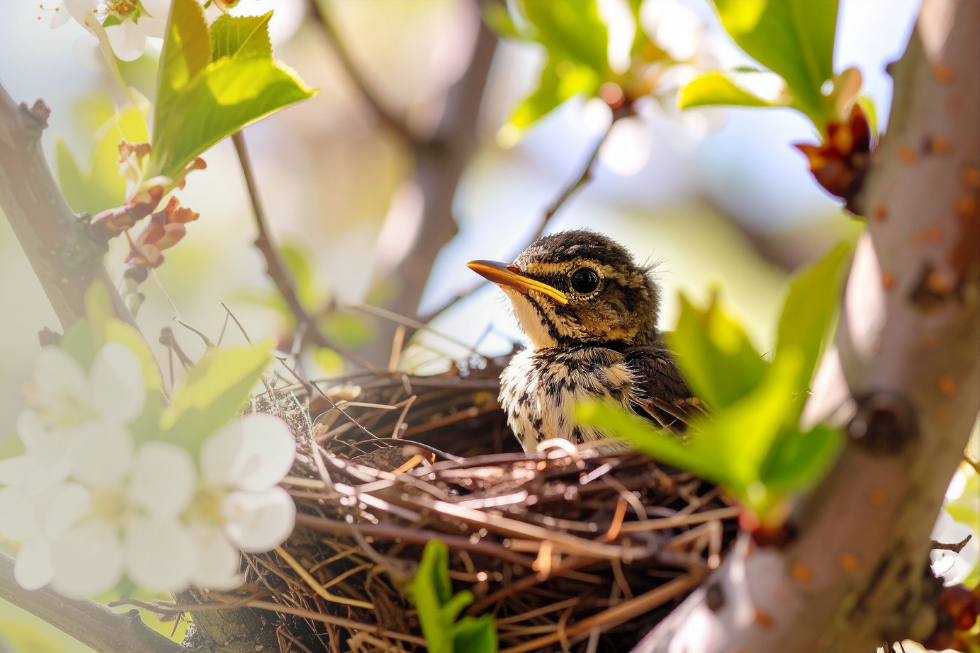
Now that spring has arrived, so too has the most sensitive time of year for birds, often referred to as Bird Nesting Season. In the Lower Mainland, most bird nesting occurs between March – August, though a few bird species start nesting earlier in the year and finish in September, or nest year-round.
Bird nesting can happen on nearly any type of site. Nests can be found anywhere from forests to buildings to empty gravel lots, and everywhere in between. Many projects will encounter some type of bird nesting issue depending on landscape context, site conditions, and the time of year when works occur.
Why Developers Need to Understand Regulatory Requirements for Bird Nesting
| Wildlife regulations are a critical consideration for developers. Compliance is a legal obligation under provincial and federal legislation, so adherence is essential to avoid project delays and penalties. |
In BC, most native birds and their active nests are protected by the provincial Wildlife Act, with active nests defined as those containing a bird or its egg. Many native birds and their active nests are also protected by the federal Migratory Birds Convention Act, 1994 (MBCA) and its Migratory Birds Regulations, 2022 (MBR). Some birds and their nests are also protected by the federal Species at Risk Act (SARA).
Two common situations where clients find value in our services are Active Nests and Nests Protected Year-Round.
Active Nests
On many sites, active bird nests will be present somewhere on site for much of the spring and summer, as our region has many species with different nesting periods. As such, the best way to avoid negative impacts to birds and their active nests is to avoid scheduling works like land clearing or building demolition during the nesting season.
If that isn’t possible, the likelihood of negative impacts can be reduced by having a Qualified Environmental Professional (QEP) conduct a bird nesting activity survey in advance of works. Should the QEP observe evidence of bird nesting activity, they will prescribe no-disturbance buffers to each nesting activity location and provide advice as to timelines for resumption of works in those areas.
Some municipalities require that proponents submit nesting activity survey reports before tree removal permits will be issued. Regardless of municipal requirements, it is every landowner’s / developer’s responsibility to ensure compliance with provincial and federal legislation.
Nests Protected Year-Round
The nests of some bird species are protected year-round (including when inactive) by either the Wildlife Act or the MBCA and MBR. Nests protected year-round by the Wildlife Act include those of eagles, peregrine falcons, gyrfalcons, ospreys, herons, and burrowing owls. Nests protected year-round by the MBCA and MBR include several species of seabirds, herons, and egrets, as well as pileated woodpecker. In the Lower Mainland, nests protected year-round are likely to be those of bald eagle, peregrine falcon, osprey, great blue heron, and pileated woodpecker. Permits to remove nests protected year-round, outside of the nesting season, may be obtained in certain circumstances.
The best way to avoid impacts to nests protected year-round is to have a QEP complete a survey for these nests well in advance of project works, ideally before site designs are finalized. Should any such nests be detected, or should the site be identified as a location where such a nest might occur, the QEP can provide advice on best practices for nest protection and permitting requirements, as applicable.
How Can we Help?
To ensure your project(s) move along successfully, and for more information on how Keystone Environmental can help you understand bird nesting season and its associated regulations, connect with Jeremy Nilson, Senior Biologist, or call 604-430-0671.